
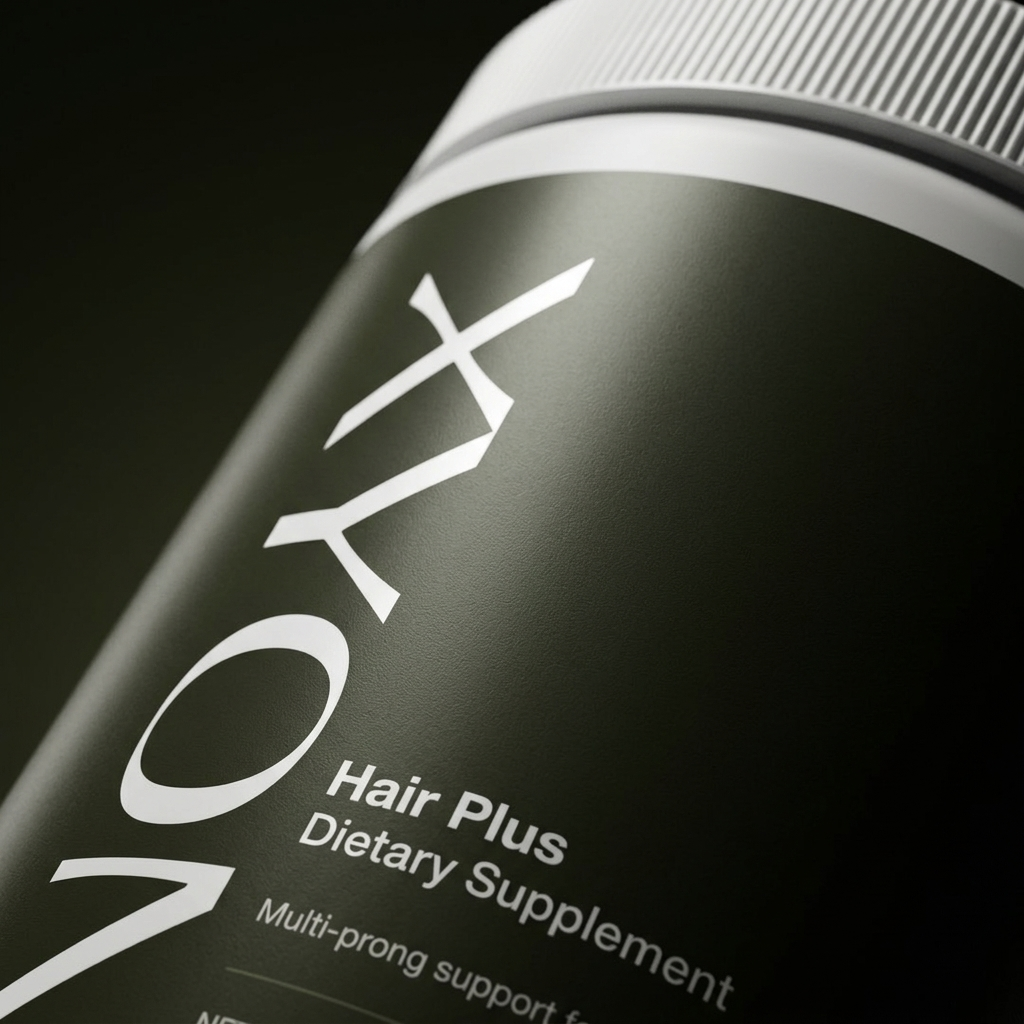


Redensyl for hair growth
Redensyl has become one of the most searched over the counter drug free hair growth ingredients. It’s marketed as a natural, topical hair growth solution that is often presented as an alternative to minoxidil. If you’re seeing Redensyl everywhere and wondering whether it actually helps your hair grow, the medical team at XYON have built this guide so you understand what Redensyl is, what the research shows, how to use it safely, and how it compares to minoxidil for helping with hair loss.
Redensyl in 30 seconds
- Redensyl is a cosmetic ingredient used in over-the-counter serums, sprays and sometimes shampoos marketed as something that can help achieve thicker looking hair.
- It’s not an FDA-approved hair-loss drug, and the clinical evidence is limited and mostly based on multi-ingredient formulas, making it hard to know what Redensyl does on its own.
- Redensyl contains a number of natural, plant based active ingredients including DHQG, EGCG2, glycine and zinc chloride.
- These ingredients are thought to stimulate hair follicle stem cells and reduce hair fall.
- It does contain sodium metabisulfite, a well known allergen. So some people with sulfite allergies, might experience allergic type reactions with use.
- If you try it, treat it as a cosmetic addition and not a standalone solution for treating your hair loss.
- For hair loss caused by androgenetic alopecia, all available evidence still supports using finasteride or dutasteride for DHT suppression and minoxidil for helping with hair growth.
Clinical Data Summary
Clinical evidence for Redensyl is limited and mostly comes from formulas with multiple ingredients, which makes it hard to determine Redensyl’s impact on hair growth. On the other hand, minoxidil, finasteride and dutasteride have been clinically evaluated for decades, supporting their meaningful impact on treating male pattern hair loss. Redensyl evidence is limited.
- A randomized, single-blinded, vehicle-controlled study of a topical active blend in the treatment of androgenetic alopecia
- A Comparative Study of Topical Procapil With Platelet-Rich Plasma Therapy Versus Topical Redensyl, Saw Palmetto, and Biotin With Platelet-Rich Plasma Therapy in the Treatment of Androgenetic Alopecia
[[RED_01]]
Table of contents
What is Redensyl?
Redensyl is an ingredient in topical hair products that promise thicker hair that is a blend of camellia sinensis (green tea) leaf extract, larix europaea (larch) wood extract, glycine, and zinc chloride mixed with supporting stabilizers. It is not a drug, like minoxidil, so some users who are cautious with taking medications like to try it instead as a natural option. It’s found in serums and sprays that are applied to the scalp and in some cases used in shampoos.
(Bikash, 2025; Pavithra et al., 2023).
Does Redensyl help hair grow?
There is limited evidence to support Redensyl as a hair loss solution. Some limited studies compared using Redensyl with Capixyl and Procapil to see if they could replicate the results of using a 5% topical minoxidil formula but these were not definitive. It can be a useful add on, but if your goal is growing healthier, thicker hair then it alone will not work.
Redensyl benefits
People typically use Redensyl for making their hair look thicker and some users have reported some reduction in shedding. It’s gentle on the scalp for most who use it, so some users who were sensitive to other options like that it doesn’t normally cause irritation. It will not help with hair loss caused by androgenetic alopecia or telogen effluvium but can be paired with other solutions such as finasteride or PRP to assist with hair growth.
Side effects
While some users like that Redensyl doesn’t irritate their scalps others have reported redness, dry scalp, and irritation, likely due to the sulfite ingredient in the formulation. If you have used Redensyl and experienced scalp irritation, look to switch away from a formulation that contains sulfites, alcohol, heavy fragrances, or propylene glycol and if you see those you can try switching to another brand to avoid the side effects.
How to use Redensyl serum
If you have decided on trying Redensyl then application is key to getting a possible positive effect from it. Here is a quick breakdown of how you should apply Redensyl.
[[RED_02]]
Step 1: Apply to scalp, not the hair
As with all topical hair growth products, Redensyl should be applied directly to the scalp and not on the hair. The goal is for the ingredients to get to the root which is the hair follicle. While there is no clinical evidence Redensyl will stimulate blood flow like minoxidil does, if you are going to experience any measurable improvement, you’ll still need the product to sit on your scalp for an extended period of time.
Step 2: Use a leave-on product if possible
The product needs time to work so if you use it in a shampoo you’ll be washing it out right away. Look for a cream, serum or spray that you can apply directly to your scalp and then leave on.
Step 3: Be consistent and patient
Hair growth happens in phases and like most, if not all hair growth products, in order to see the effects, the hair needs to switch cycles. If you’re using Redensyl to help with hair loss and to grow thicker hair, then use it consistently and watch for results in 3 to 6 months.
Step 4: Don’t stack it onto too many other products
If you’re also using minoxidil, ketoconazole, retinoids, or exfoliating acids, introduce Redensyl slowly to avoid irritating your scalp.
Redensyl vs minoxidil
Minoxidil is much better than Redensyl for assisting with hair growth when experiencing hair loss. Redensyl can be a useful as an add on in your hair growth routine but will not get the same results as using minoxidil and the results will be cosmetic (your hair might look a bit thicker). You can use both if you’re hoping to maximize the effects because some users have reported cosmetic improvement in hair thickness when doing so. Combined with finasteride to block the DHT that causes hair loss, minoxidil and Redensyl can get great results, so if you’re hoping to restore your hair medically, it is worth considering it as an addition.
(Kaufman et al., 1998; Olsen et al., 2002; Lucky et al., 2004; Gupta & Charrette, 2015; Hu et al., 2015; Chen et al., 2020; Bikash, 2025).
Which brand is best?
The best products with Redensyl that will affect your hair growth are leave-on topicals with clearly defined ingredients that aren’t loaded with anything that can irritate your scalp. If you see too many additional ingredients, then look for something else since you’re already looking to add this into your existing routine and there is no need to take risks with other substances.
Where to buy Redensyl
There are lots of options for buying Redensyl online, but that availability also increases the risk of getting something with too many additional ingredients. Buy directly from the brand’s website and not in marketplace websites to avoid low quality vendors and if you see improbable promises related to stopping your hair loss or regrowing hair then treat that as a red flag.
Redensyl shampoo, oils, and combos (Capixyl/Procapil)
Redensyl oil is an inaccurate name for the product since as mentioned, it is only ever an ingredient. If you see something named Redensyl oil you should look at the label so you know what else is in it in case there are any other ingredients in it that you know you will have a negative reaction to. When Redensyl is combined with Capixyl and Procapil, some vendors will attribute the effects to one ingredient alone, when in fact it’s the full combination that likely yielded any results.
When compared to 3% minoxidil, Capixyl combined with biochanin A + acetyl tetrapeptide-3 and ginseng extract did show some positive results in helping treat androgenetic alopecia, but the study was very small and doesn’t provide nearly as much proof it works compared with the decades of studies on minoxidil. Procapil has limited clinical data with the best information being a short report evaluating a topical caffeine + Procapil 3% formulation. It showed some improvement in treating male pattern hair loss but again nothing nearly as conclusive and effective as minoxidil. Aminexil / kopexil (diaminopyrimidine oxide) did perform well in tests on mice and improved their hair growth, but there is no evidence that it will be effective for humans and again, minoxidil is the preferred option.
Any Redensyl in shampoos will likely not be clinically effective since it will be washed out immediately and therefore, has no opportunity to penetrate the scalp and reach the hair follicle. So if you see a shampoo that claims to be root activating or uses other claims to help with hair loss you probably should dismiss them.
(Bikash, 2025; Lueangarun & Panchaprateep, 2020; Samadi et al., 2024; Jalilzadeh et al., 2024).
FAQs
Is Redensyl good for hair growth?
Redensyl can be a reasonable cosmetic-support ingredient, especially for early thinning or density goals, but the strongest evidence still favors minoxidil and 5 alpha-reductase inhibitors for regrowth outcomes.
Does Redensyl work for hair loss?
It may help some people, particularly in blends and over longer use windows, but it’s best viewed as supportive—not a replacement for clinically proven AGA therapies.
What are Redensyl side effects?
Most issues are scalp irritation from the overall formula and some of the ingredients (like sulfites) eg dryness, itch, redness. Patch testing and slow titration can reduce the risk.
How long does Redensyl take to work?
Plan to assess at 12 weeks minimum, and ideally 3–6 months with consistent use and progress photos.
Is it spelled “Redynsyl” or “Redesyl”?
Those are common misspellings you’ll see online (redynsyl, redesyl, redensil, etc.). The ingredient people usually mean is Redensyl™.

Dr. Simon Pimstone, MD PhD FRCPC
Physician-Scientist; Founder, Director, and Chief Executive Officer
XYON: Founder, Director, and CEO
Education
Doctorate of Medicine (MD) — University of Cape Town, South Africa — 1991
Genetics (PhD) — University of Amsterdam, The Netherlands — 1998
Internal Medicine (Postgraduate Fellowship) — University of British Columbia (UBC), Canada — 2001
Academic & Clinical Appointments
Clinical Assistant Professor, Division of General Internal Medicine — University of British Columbia
Associate Member, Division of Cardiology, Department of Medicine — University of British Columbia
Faculty — Providence Health Care Heart and Lung Institute
References:
Bikash, C. (2025). Topical Alternatives for Hair Loss: Beyond the Conventional. Int J Trichology, 17(1), 13–19. https://pmc.ncbi.nlm.nih.gov/articles/PMC12251978/
Pavithra, T. R., Rajashekar, T. S., Suresh Kumar, K., & Prasanna, H. (2023). A Comparative Study of Topical Procapil With Platelet-Rich Plasma Therapy Versus Topical Redensyl, Saw Palmetto, and Biotin With Platelet-Rich Plasma Therapy in the Treatment of Androgenetic Alopecia. Cureus, 15(5), e38696. https://pmc.ncbi.nlm.nih.gov/articles/PMC10246929/
Katoulis, A. C., et al. (2020). A randomized, single-blinded, vehicle-controlled study of a topical active blend in the treatment of androgenetic alopecia. Dermatol Ther. https://pubmed.ncbi.nlm.nih.gov/32473084/
Kaufman, K. D., et al. (1998). Finasteride 1 mg trials. J Am Acad Dermatol. https://pubmed.ncbi.nlm.nih.gov/9777765/
Hu, R., et al. (2015). Combined treatment with oral finasteride and topical minoxidil in male androgenetic alopecia. https://pubmed.ncbi.nlm.nih.gov/26031764/
Chen, L., et al. (2020). Efficacy and safety of finasteride combined with topical minoxidil. https://pubmed.ncbi.nlm.nih.gov/32166351/
Lueangarun, S., & Panchaprateep, R. (2020). An efficacy and safety of 3% minoxidil versus 3% redensyl. https://pubmed.ncbi.nlm.nih.gov/33584955/
Samadi, A., et al. (2024). Efficacy and safety of a topical caffeine + Procapil 3% formulation. https://pubmed.ncbi.nlm.nih.gov/37990760/
Jalilzadeh, S., et al. (2024). Aminexil (diaminopyrimidine oxide) vs minoxidil context. https://pmc.ncbi.nlm.nih.gov/articles/PMC12008251/
